
MWG digital

The best of Max Weber – Reading Reccomendatios
-
For Beginners
- Science as a Vocation. Why should anyone – considering the precarious external conditions – decide to become a scientist? Lecture given in November 1917 to students in Munich, published as a pamphlet in 1919 🔗MWG I/17, S. 49-111
- Politik als Beruf. Was unterscheidet „Windbeutel“ von guten Politikern? Rede im Revolutionswinter 1919 🔗MWG I/17, S. 113-252
-
For the informed
- Protestant Ethics and the ‘Spirit’ of Capitalism.
On the religious and ethical influence on the modern working world.
Max Weber's most famous text, which has been translated into almost every language
around the globe. Written in 1904/05 and
revised in 1919/20 => the early version is already
available online:
🔗MWG I/9, S. 97-425 und 🔗https://mwg-digital.badw.de/protestantische-ethik-1/ - Economy and Society Weber's magnum opus,
featureing terminology that nowadays constitutes the basic dictionary of
of sociology but also lays foundations in the fields of
theology, law, and the sociology of power and cities.
Recognised by the International Sociological Association as one of the
most important books of the 20th century.
Now online in 6 volumes:
- 🔗MWG I/23 mit den von Max Weber autorisieren Kapiteln, u.a. den „Soziologischen Grundbegriffen“ und den „Typen der Herrschaft“
und die nachgelassenen, von Marianne Weber herausgegebenen Textkonvolute:
- Protestant Ethics and the ‘Spirit’ of Capitalism.
On the religious and ethical influence on the modern working world.
Max Weber's most famous text, which has been translated into almost every language
around the globe. Written in 1904/05 and
revised in 1919/20 => the early version is already
available online:
-
For the thoughtful
- The "Objectivity" of Knowledge in Social Science and Social Policy. 1904. A
foundational text, especially for historians.
🔗MWG I/7, S. 135-234 - Über einige Kategorien der verstehenden Soziologie. 1913. A conceptual toolkit for sociologists. 🔗MWG I/12, S. 383-440
- Der Sinn der „Wertfreiheit“ der soziologischen und ökonomischen Wissenschaften. 1917. ‘Wertfreiheit’ does not mean a lack of opinion, but rather critical distance and separation of factual knowledge and value judgements. Read in: MWG I/12, S. 441-512
- And what many people do not know: the original text was written as early as 1913 on the occasion of an internal debate in the Verein für Socialpolitik (Association for Social Policy), which can be read in: 🔗MWG I/12, S. 329-382
- Zwischenbetrachtung: Theorie der Stufen und Richtungen religiöser Weltablehnung. A magnificent and multi-layered analysis of modern culture as an interlude in the universal historical comparative „Wirtschaftethik der Weltreligionen“. MWG I/19, S. 479-522
- The "Objectivity" of Knowledge in Social Science and Social Policy. 1904. A
foundational text, especially for historians.
-
For the spirited
- Der Nationalstaat und die Volkswirtschaftspolitik. Max
Weber's inaugural speech in Freiburg in May 1895, which leaves little to be desired
in terms of clarity and brutality. At the same time, however, it is a frank confession.
🔗MWG I/4, S. 535-574 - The Ruge affair. In early 1911, Max Weber responded to public attacks against his wife and the women's movement. This marked the beginning of lengthy court proceedings, which were also accompanied by challenges to a duel. The prelude can be read in: MWG I/13, S. 235-242
- Objective (allegedly ‘political’) remarks on 19 January [1920 on the Arco case]. When Max Weber loses his temper and ventilates his feelings in the face of ‘stupidity’... MWG I/16, S. 268-273
- Der Nationalstaat und die Volkswirtschaftspolitik. Max
Weber's inaugural speech in Freiburg in May 1895, which leaves little to be desired
in terms of clarity and brutality. At the same time, however, it is a frank confession.
-
For pearl hunters
- Zur Lage der bürgerlichen Demokratie in Rußland. 1906. A pioneering work analysing the potential voting behaviour of the Russian population during revolutionary upheaval, for which Max Weber learned Russian in just a few weeks. MWG I/10, S. 71-279
- Zur Musiksoziologie. Nachlaß 1921. Mathematically detailed, Weber introduces the reader to the ‘harmonically rationalised music’ of the Occident and explains, among other things, why the piano is "a bourgeois piece of furniture". His thesis that rationalisation – in contrast to all other cultures – has also taken hold in the supposedly irrational field of music in the West is shocking. 🔗MWG I/14
A Classic goes online ...
MWG digital
MWG digital MWGdigital is the digital edition of the Max Weber Gesamtausgabe (MWG) and a forward-looking digital text offering from the Bavarian Academy of Sciences and Humanities (BAdW). It responds to changing reading habits in the age of digitalisation. Max Weber is a classic figure in 20th-century social and cultural studies. His multi-layered, universal historical work, rich in categories, his provocative theses and profound questions are still relevant today and stimulate reflection. The texts of this modern classic should therefore be available in a digital format. In this way, Max Weber remains alive in social and scientific discourse, especially for a younger and more international generation.

From MWG to MWG digital
MWG digital transforms the 47 published Volumes of the Max Weber-Gesamtausgabe (MWG) and their 35.018 individual pages into a high-quality digital format. The printed edition, which was published from 1984 to 2020, was originally published on behalf of the commission of social and economic history at the Bavarian Academy of Sciences. MWG consists of the complete collected works of Weber, his writings, speeches, correspondence and lectures, in a historically-critical edition. Mehr zur MWG-Druckausgabe.
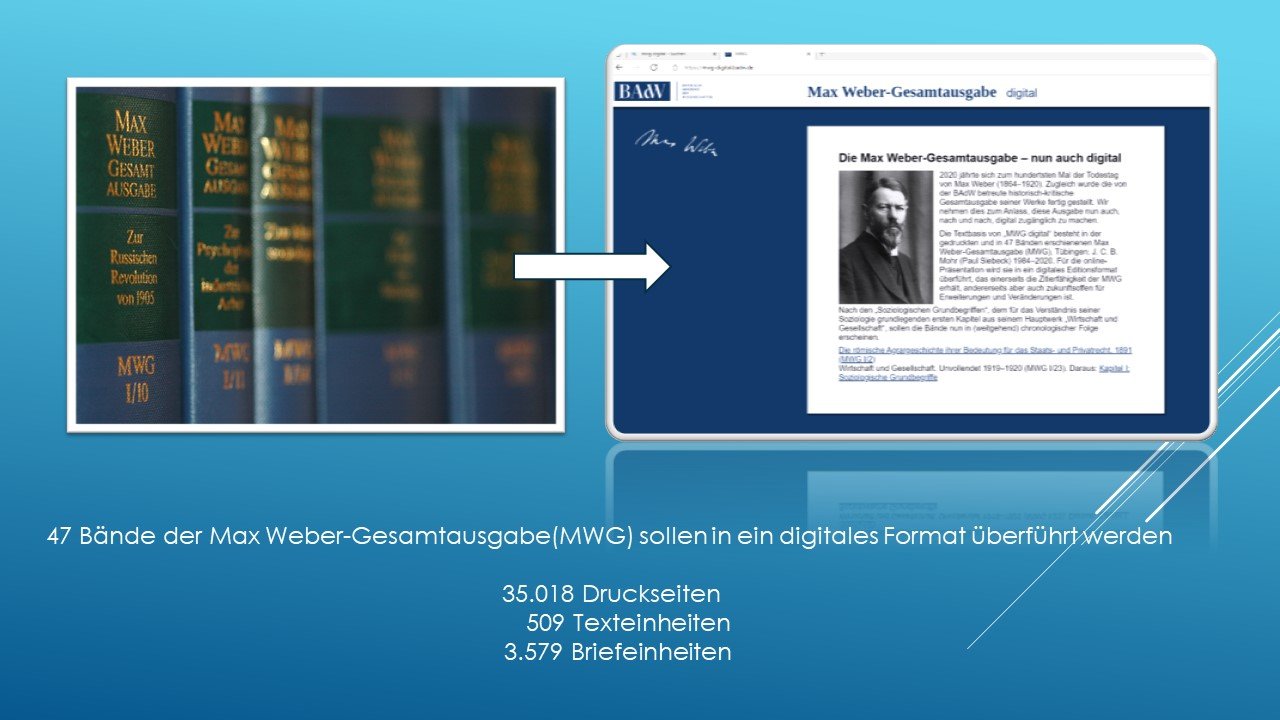
Digital text rendering
MWG digital MWGdigital presents Max Weber's texts as electronic continuous text, i.e. not in the page layout of the printed edition or as in the eBook edition published by Mohr Siebeck. Nevertheless, citation compatibility with the MWG printed edition is maintained.
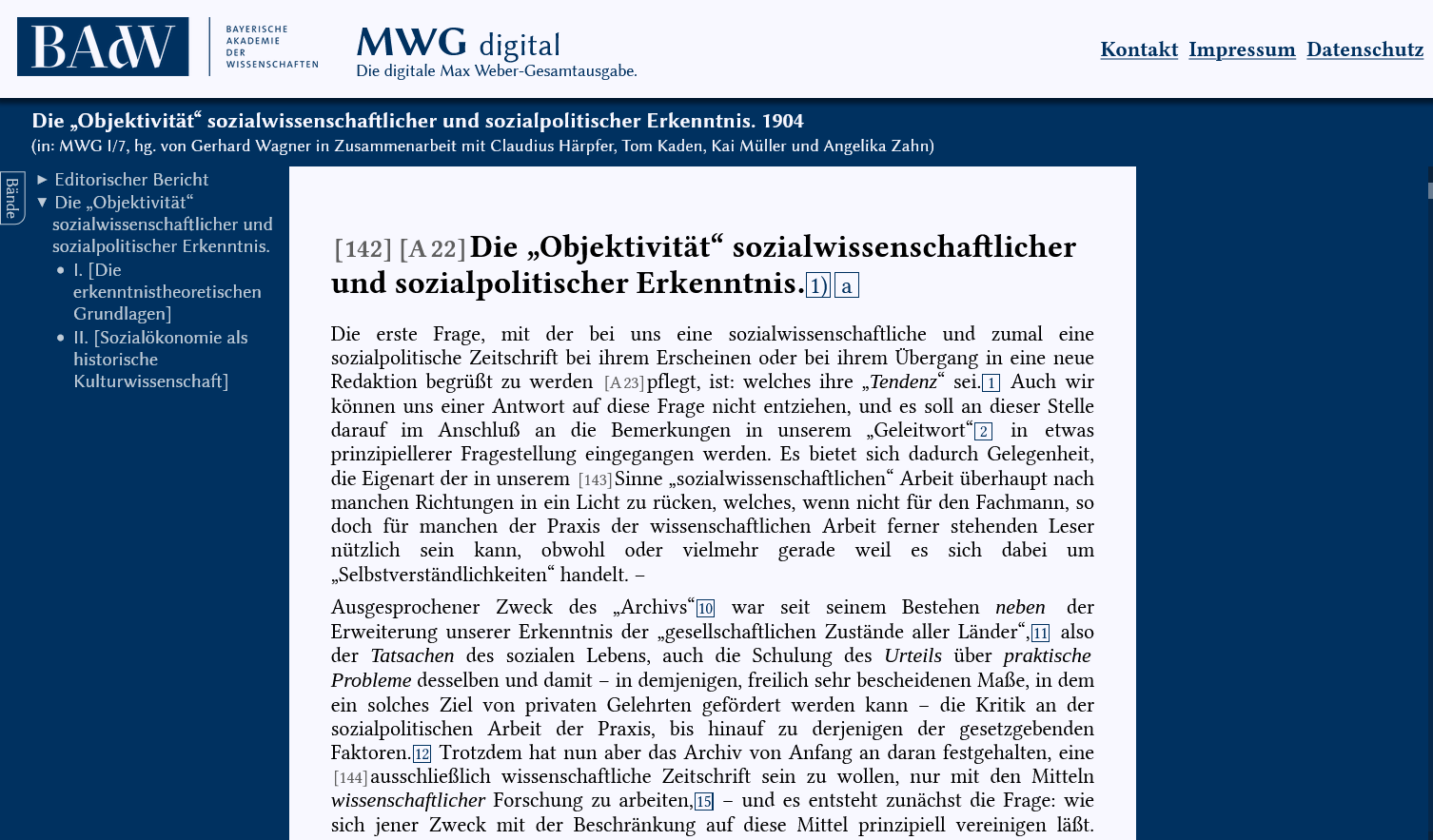
The first layer of visibility in the MWGdigital shows only the original writing by Weber. Any additional Information can be viewed by clicking on it:
- Weber's original footnotes
- Editorial explanations
- Critical apparatus with evidence of textual interventions or textual variants
The added value of the digital edition
Printed editions fix texts in a certain state. These
are then finalised and cannot be changed. The digital edition, on the other hand,
can be changed and expanded if new findings, new text discoveries,
etc. come to light.This creates the opportunity to keep the text collection open and
alive. However, in accordance with scientific quality standards, MWG digital only makes changes after rigorous
review by experts at the BAdW
The digital edition offers new possibilities through the
integration of digitised material:
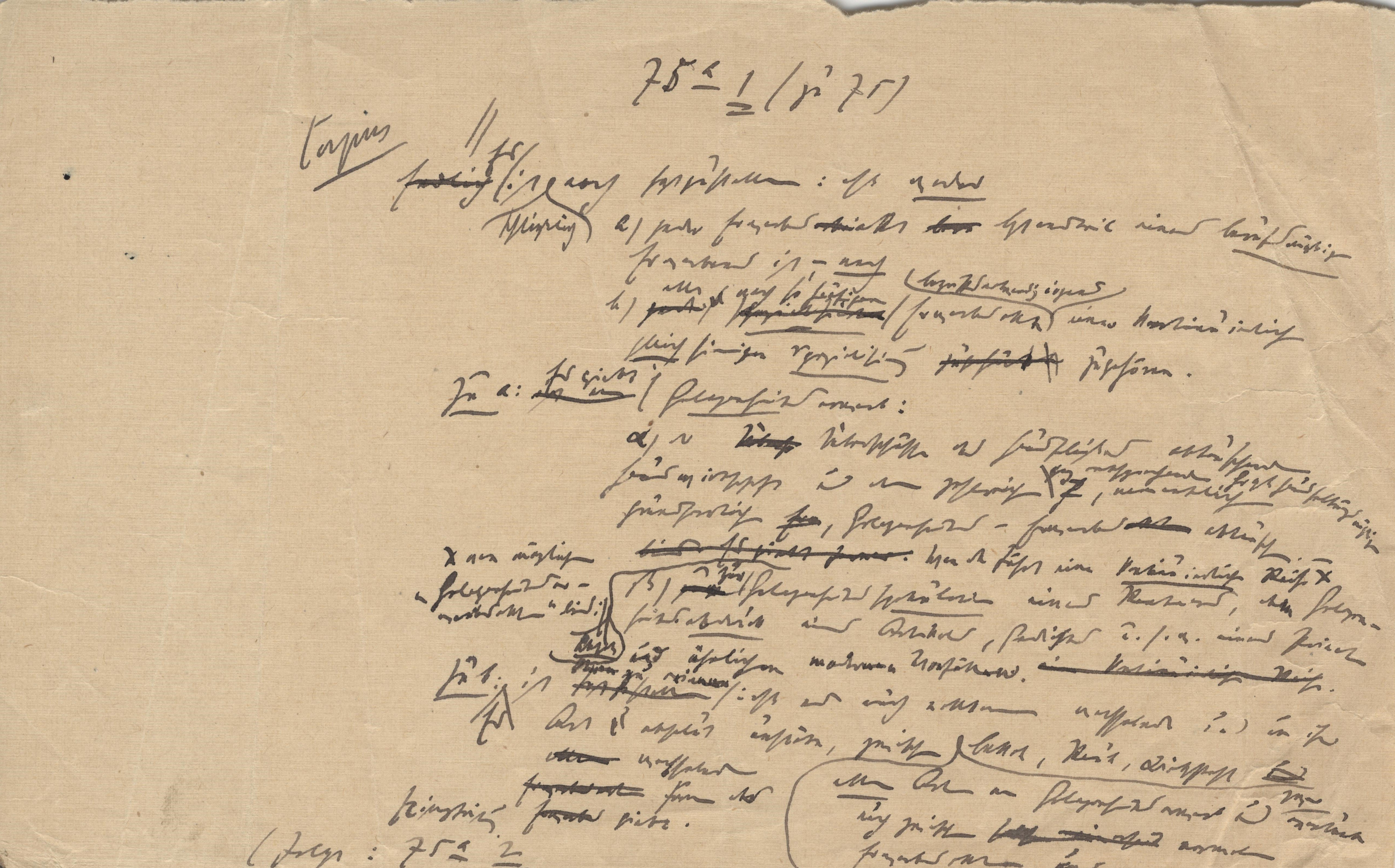
- Original manuscripts and notes
- letters, postcards, telegrams
- First prints and proofs
- Magazine and newspaper articles
Search function
The printed edition of the MWG
fills several metres of shelf space with its 47 volumes.
Max Weber's complete works were divided by the
MWG editors according to various criteria, a
combination of relevance and chronology. In order to
find a text, a specific quotation or a passage from a letter,
it was previously necessary to be very familiar with the work.
MWG digital
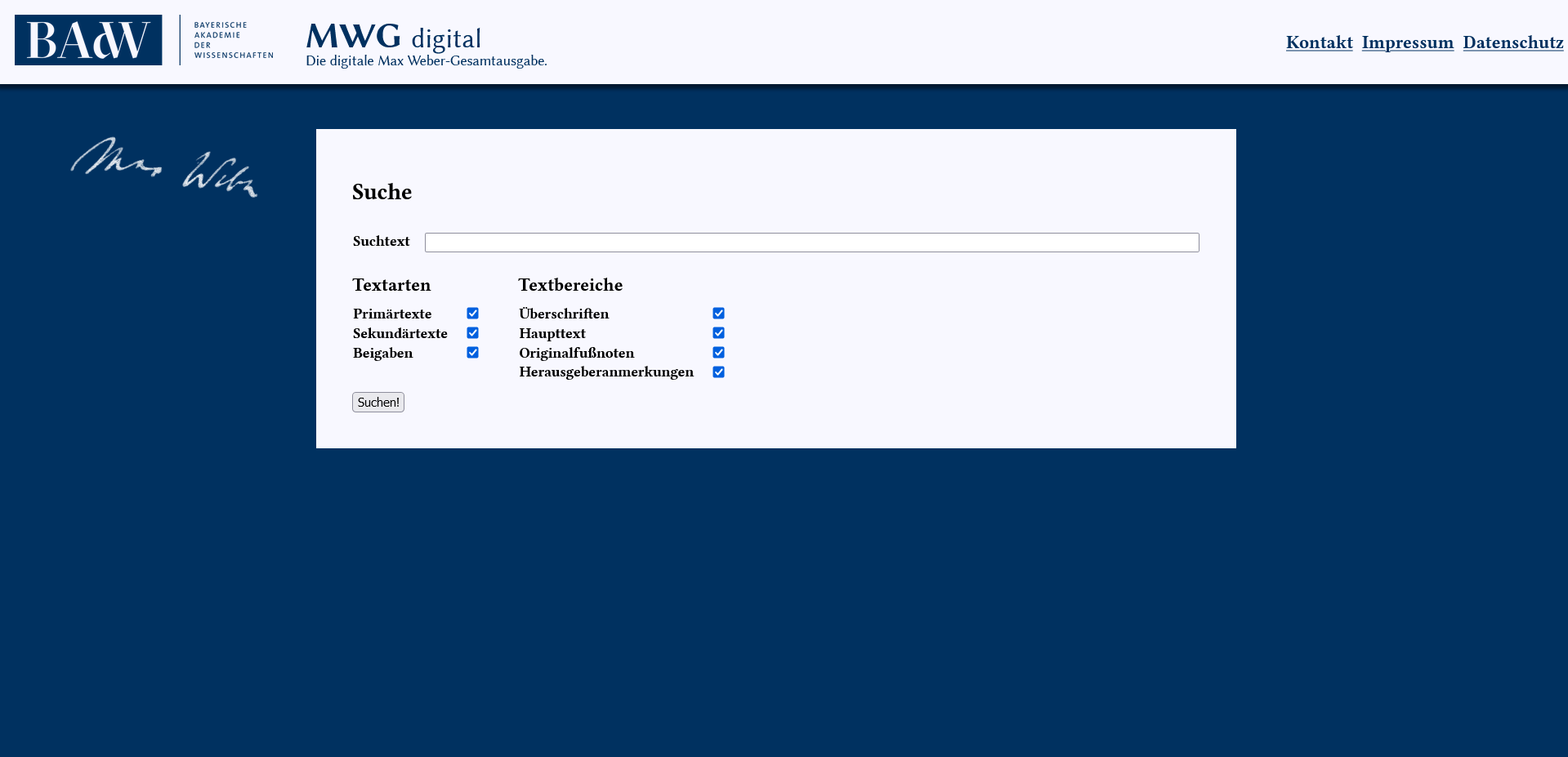
however, offers a search function across all volumes which sharpens the
eye for continuities in content, but also for changes in the biographical context of the work.
The search function enables
quick and targeted access to texts. In addition, the search mask offers the option of filtering by
reference points in Weber's text or editor information.
A search function within only one text search is not currently available for technical reasons; however,
for this purpose, the browser search function via F3 or CTRL+F may be used.
What MWG digital has to offer
- free, low-threshold access to texts (= Open Access)
- direct, straightforward access to the text
- die freie Durchsuchbarkeit der Texte
- downloading the text
- printing the text
- further processing of the texts
- networking of text information with other and higher-level database systems.
→ MWG digital democratises and internationalises access to Max Weber's work.
→ Access is free of charge and available anywhere in the world.
- the high quality of the print edition
- citation compatible with MWG, i.e. finding specific quotes MWG I/17, S. 111, Anm. 66 (Beleg für Zitat „Forderung des Tages“)
- [in development:] the traceability of changes compared to the printed edition
- die Compliance with legal requirements and data conventions
Publishing rules of MWG digital
MWG digital: Rediscovering Max Weber's works
MWG digital makes Max Weber's texts digitally accessible. The clearly structured, linguistically edited and editorially annotated texts are transferred into a digital format. Weber's main text remains the focus, while notes, text variants and explanations can be displayed by a simple click of the mouse. Newly discovered texts and original historical documents also enrich the digital edition. In this way, MWG digital combines the highest academic standards with a user-friendly text presentation.
Publishing rules of MWG digital
MWG digital is based on the high editorial standards established by the MWG (Max-Weber-Gesamtausgabe). Editorial rules form the methodological foundation of scholarly text editing: they ensure transparent, comprehensible documentation of text selection, editing and presentation.
From Image PDF to web format
OCR
Scanning of individual printed pages (PNG image files) using ABBYY Finereader optical character recognition software; manual correction of text blocks and content
Single-page correction
Line-by-line proofreading of texts, apparatus and text formatting
Formatting the whole document
Automated segmentation and conversion of texts into formatted complete texts; assignment and linking of text and apparatus
Correction of the entire document
Correction of the complete texts, apparatus and editorial explanations
Final correction/h1>
Proofreading of final texts in XML (with HTML preview)
Online publication
Implementation of the search function, uploading and publication of text documents in HTML
Technical data and licences
The digital long-term archiving of MWGdigital is guaranteed in the long term by
the Leibniz Rechenzentrum (LRZ) of the Bavarian Academy of Sciences and Humanities. The LRZ is the
IT service provider for Munich's universities and colleges as well as
for scientific institutions in the Free State of Bavaria. As a national
and European high-performance computing centre, the LRZ has decades of expertise
in the field of computer and information technology
and world-leading high-performance computers.
The text content of MWG
digital is provided on the BAdW website in open access under the Creative Commons BY 4.0 licence
and in accordance with the FAIR principles to which the
BAdW is committed.
Rights: The processing and digital publication of the
MWG printed volumes by the BAdW is carried out with the contractual consent of the Mohr Siebeck publishing house in Tübingen.
Our Team
MWG digital is an in-house project of the Bavarian Academy of Sciences and Humanities involving its staff members from the Digital Humanities and Research Documentation departments.
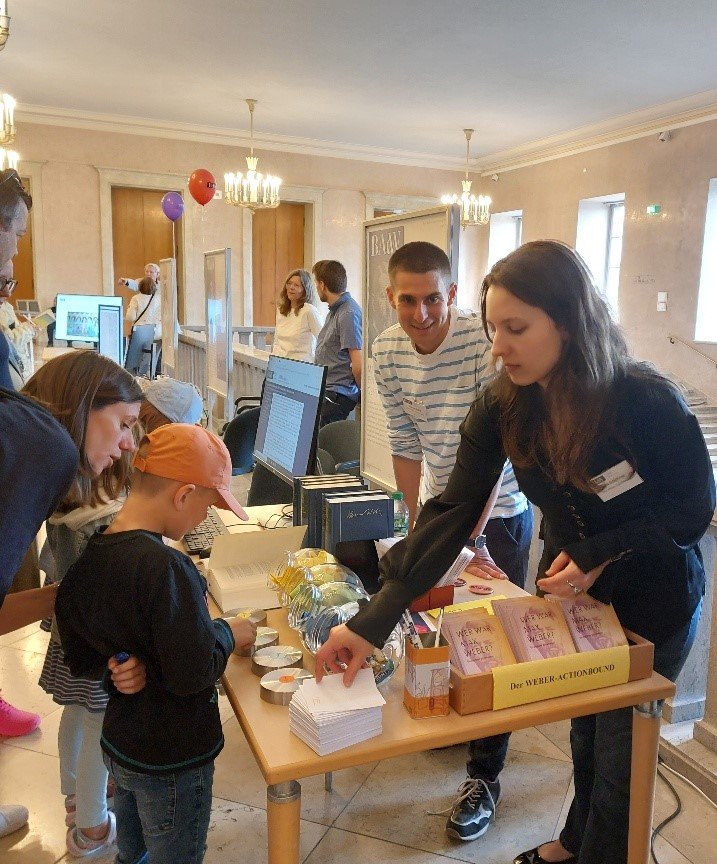
© Edith Hanke